
More than 2 million school-aged children in South Sudan are not in school. Behind that number are young people with ambitions to learn, work and contribute to their communities, and barriers that make it hard to stay in class. Here’s what the education system looks like, why girls face the greatest obstacles, and how the VAD Foundation is helping students move from school access to lasting opportunity.
What is the South Sudan education system like?
South Sudan became the world’s 195th country in July 2011. Its education system was already deeply damaged by two decades of civil war, from 1983 to 2005, which cost 2.5 million lives and displaced nearly 6 million people. Renewed conflict beginning in December 2013 displaced more than 3.6 million more people.
The formal education structure is commonly described as two years of pre-primary, eight years of primary school and four years of secondary school. But the structure on paper does not guarantee that children can attend or complete school. Conflict and displacement have disrupted education, and many communities are rebuilding access to classrooms and learning opportunities.
The VAD Foundation began this work in 2006, before South Sudan’s independence. Valentino Achak Deng, a former South Sudanese refugee whose life inspired Dave Eggers’ novel What Is the What, co-founded the organization with Eggers. The Foundation began by building a school in Valentino’s home village of Marial Bai. Our approach continues to connect learning with the community’s long-term needs. Read more about our work in South Sudan and programs.
How many children are out of school, and what is the South Sudan literacy rate?
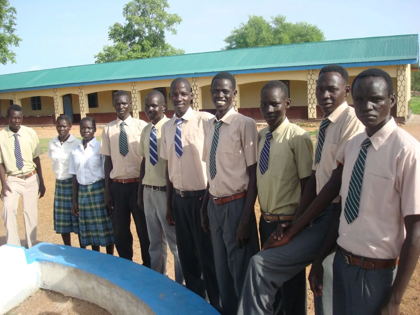
VAD Foundation students gathered at Cornerstones Vision Academy in Aweil, South Sudan.
More than 2 million school-aged children in South Sudan, over 70%, are out of school, according to UNICEF figures cited by the VAD Foundation. UNICEF’s 2023 estimate put the number at 2.8 million, including 53% girls. The estimates differ by year, but each shows the scale of the challenge. UNICEF also reports that one in five children who enroll drops out.
The South Sudan literacy rate is also low. Estimates vary depending on the year and measure: a national report estimated overall literacy at 34.5% in 2020, while UNESCO has reported that more than 70% of people over age 15 are illiterate. These figures underline why access to consistent schooling matters, not only for children today, but for communities’ future opportunities. UNICEF’s overview of education in South Sudan describes the scale of exclusion and the challenges facing schools and teachers.
Why are girls hit hardest?
Girls are the largest out-of-school group. Poverty and child marriage are major barriers: families under financial pressure may have to make difficult choices, and early marriage can interrupt or prevent a girl’s education. As a result, girls are more likely to miss the chance to continue their studies.
Keeping girls in school takes more than opening a classroom door. It means supporting them as they progress through elementary and high school, and creating opportunities for them to participate fully in school life. A soccer field, a computer lesson or a drama performance can help make school a place where girls’ abilities and ambitions are visible.
At Cornerstone Vision Academy in Aweil, the VAD Foundation’s Scholars Program focuses especially on girls. In 2024, we sponsored 372 girls: 183 in elementary school and 189 in high school. This year, 119 scholars are graduating from elementary or high school.
Students also receive computer training before high school graduation. Soccer and volleyball challenge gender stereotypes, while a regional high school drama festival gives students a stage to use storytelling to advocate for gender equality.
Mary Agot, a student, describes what education means to her:
“I come to school so I can be an educated person in the future. When I finish school, I want to be a doctor and help my nation, those in my community, and others from outside.”
Mary Agot, Student
What actually works? Sponsor girls, build the school, then add skills
When we ask what supports education in South Sudan, our answer is a connected approach: help girls attend and complete school, invest in the places where they learn, and link education to practical skills and livelihoods.
Sponsor girls through school. The Scholars Program partners with Cornerstone Vision Academy to help girls access elementary and high school, with opportunities that extend beyond classroom lessons.
Build spaces for learning and community. In late 2024, the Foundation broke ground on the Bobby Newmyer Dining Hall and Auditorium at Cornerstone Vision Academy. The project will provide students with a communal dining space and a venue for school and community events.
Connect learning with practical skills. Our work goes beyond the classroom. Farming programs teach horticulture, aquaculture and animal husbandry. The Foundation has established what it describes as South Sudan’s only fishponds and aquaculture training programs. Vocational training includes carpentry, metalwork, welding, masonry and tailoring. These skills give students, youth and women ways to build livelihoods alongside their learning.
That combination matters. Education builds knowledge and opens possibilities; farming and vocational skills help people apply what they learn in daily life and local economies. The programs are designed to strengthen not only individual futures, but community resilience too.
Frequently Asked Questions
How many children in South Sudan are out of school?
More than 2 million school-aged children in South Sudan, over 70%, are out of school, according to UNICEF figures cited by the VAD Foundation. UNICEF estimated 2.8 million out-of-school children in 2023.
What is the education system in South Sudan like?
South Sudan’s formal education structure is commonly described as two years of pre-primary, eight years of primary school and four years of secondary school. Access and completion remain major challenges, and conflict has repeatedly disrupted education.
How can I help education in South Sudan?
You can support the VAD Foundation’s education, farming and vocational skills programs by making a donation. Your support helps sustain community-led opportunities for students, youth and women. A student’s education can open a path toward serving their family and community. Help the VAD Foundation support girls’ schooling and the programs that build opportunity beyond the classroom.
